
about
Welcome to
Lester Public Library
Whether you are a life-long resident or new to Two Rivers, Lester Public Library is here to meet your informational and recreational needs. Our beautiful facility, located on the shores of Lake Michigan, makes us a destination for tourists and residents alike.
Once inside our doors you will find a dedicated staff to guide you through collections, services and maybe even recommend a good place for lunch. We want your experience at the Lester Public Library to be a good one. Local history, novels, movies, documentaries, research materials, magazines, Wi-Fi, internet access and much more are at your fingertips.
As a member of the Manitowoc-Calumet Library System you have access to library collections from Manitowoc, Brillion, New Holstein, Kiel, and Chilton. I encourage everyone to get a library card, take full advantage of our consortia and all we have to offer right here in beautiful Two Rivers.
See you at the library!
Jeff Dawson
Director
Library History

Exterior view of the original Joseph Mann Library in 1891. The building was later used for city hall. Courtesy Hubert R. Wentorf Photo Collection, Lester Public Library.
Joseph Mann Library Opened in 1891 at Two Rivers
On October 16, 1890, concerned about the lack of library services in Two Rivers, members of the Chautauqua Reading Circle held a public meeting at Turner Hall to consider the establishment of a public library and reading room. The local group, formed in 1885, was part of the national adult educational and social movement in the United States that peaked in popularity in the late nineteenth and early twentieth centuries.
At the meeting, letters in support of the project were read and several speakers endorsed the library. Leopold Mann indicated he would donate $500 and a site for the building.
By January 19, 1891, $1,122 in subscriptions had been received from more than 300 persons. Mrs. Joseph Mann of Milwaukee donated $1,000 on the condition that the library be named after her late husband Joseph Mann, which was approved.
Before any building bids were accepted, the organization incorporated on February 2, 1891 as the Joseph Mann Library Association. The association consisted of all persons who had donated one dollar or more. The first meeting was held on March 2, 1891. The association was led by five officers and nine directors.
On July 21, 1891, the Manitowoc County Chronicle reported, “Work on the library building is now in progress” and on October 13, “The building for the Joseph Mann Library is nearly completed.” The two-story front-gabled frame library building was located on Lots 3 and 4, Block 72, south of Main (now Sixteenth) Street between Washington and Adams Streets. The total cost of construction, heater, furniture and books was $3,363.73.
The Joseph Mann Library opened to the public on December 17, 1891. The collection consisted of 846 circulating books, 36 reference books and 478 public documents. Several magazines and newspapers were available, but did not circulate.
Lizzie Yahnke was hired as the first librarian at an annual salary of $75 as well as free living quarters and heat in rooms above the library. Library hours were each evening, except Sunday, and every Monday, Wednesday, Saturday and Sunday afternoon. Anyone 14 years old could check out one book at a time for two weeks and renew it for one week. The fine for an overdue book was 3¢ per day.
On January 27, 1893, the Joseph Mann Library Association deeded the library to the city with stipulations the name would be retained and not less than $500 of public funds would be appropriated annually for library maintenance, books and other expenses.
In 1899, Herman Voshardt, a partner in the architectural sheet metal firm of Friedley-Voshardt Co., Chicago, and a former Two Rivers resident, donated decorative copper sheeting for the walls and ceiling in the reading room at the library. The artistic interior ornamentation made the room “unique among those of like institutions” in the state.
By 1914, the library needed more space. A Mission-style building, designed by the Madison architectural firm of Claude and Stark, was built across from the original library on Sixteenth Street, partly funded with a $12,500 grant from philanthropist Andrew Carnegie. Building additions were completed in 1953 and 1969.
The original library building was given to the city and used as city hall for 40 years. In 1953, municipal offices were moved to the converted Vocational Building, formerly the H. P. Hamilton School, on the east side of the public square.
By the end of the 20th century, the Joseph Mann Library was again overcrowded and a new facility was needed. A new modern library, renamed the Lester Public Library, opened at 1001 Adams Street in 1997. Today’s library continues a 132-year-long legacy of providing new technologies, programs and collections in a variety of formats for the benefit of adults and youth in the Two Rivers community.
Bob Fay is a historian and former executive director of the Manitowoc County Historical Society.
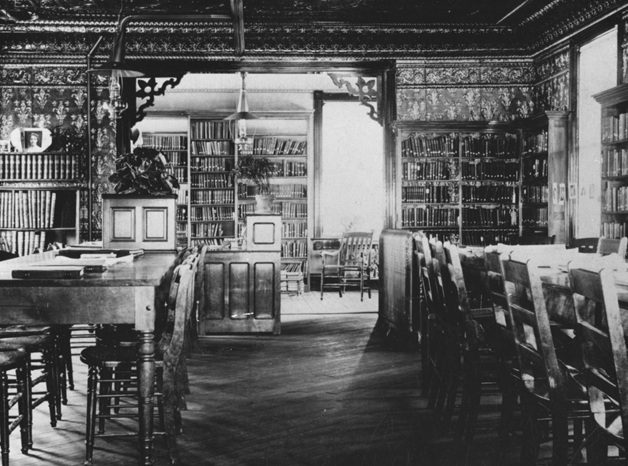
Interior view of Joseph Mann Library, 1902. Courtesy Hurbert R. Wentorf Photo Collection, Lester Public Library.

New Free Public Library, Two Rivers, Wis., 1914 H. C. Benke postcard.
Two Rivers’ Carnegie Library Dedicated in 1914
The Joseph Mann Library was built in 1891 on Main (now 16th) Street in Two Rivers. By 1912, the library had outgrown its space and a larger building was needed. A building committee, consisting of John F. Magee, Henry C. Wilke and Dr. Eugene Gates, was appointed to consider a larger facility.
In August 1912, the building committee sent a letter to James Bertram, Andrew Carnegie’s secretary, requesting a donation of $20,000 to build a library. The previous year, the Carnegie Corporation had endowed $125 million to support all of its charities, including libraries.
On January 9, 1913, the committee was notified that $12,500 from steel magnate and philanthropist Andrew Carnegie would be received.
The site selected for the new free public library was the George Wehausen property, just east of the old library. When some difficulty arose in obtaining a clear title to the property, a lot on the north side of 16th Street, directly across from the existing library, was donated by brewery owner Charles Mueller.
A Prairie School-style building, 60 by 34 feet, designed by the Madison architectural firm of Claude and Starck, was completed in 1914. The building was constructed of cream brick and featured an arched front doorway, low-pitched green tile roof with wide eaves, white stone trim, steam heat and electric lights.
The main floor consisted of reading, reference and children’s rooms. Rooms were softly lit for reading books, magazines and newspapers. Floors were covered with heavy linoleum. A meeting room, storage and furnace rooms and restroom were located in the basement, or lower level.
Frank Wolfe, brick mason, submitted the low bid of $11,643 and was awarded the contract on October 16, 1913. Local labor and materials were used in construction. John Reiss did the carpentry and woodwork. Interior painting was done by Fred Viel. Fixtures and tables were made by the Alberts & Meyer Mfg. Co.
By February 1914, the new library building was nearly completed. A public drinking fountain and light pole, erected in memory of Leopold and Clara Mann in 1902, was moved across the street from the old library and placed in front of the new building.
On June 4, 1914, the Carnegie library was dedicated. An open house and afternoon reception with music by the Gloe-Naidl orchestra was held. An evening program featured speeches by J. F. Magee, library board president, Mayor Conrad Baetz, and Matthew Dudgeon, of the state library commission, who spoke on ‘The Library, A Community Asset.’ Musical selections included a vocal duet by teachers Gleason Scoville and Josephine Treat and the Liederkranz Male Quartet.
Although a Carnegie Library, the name of the old Joseph Mann Library was retained.
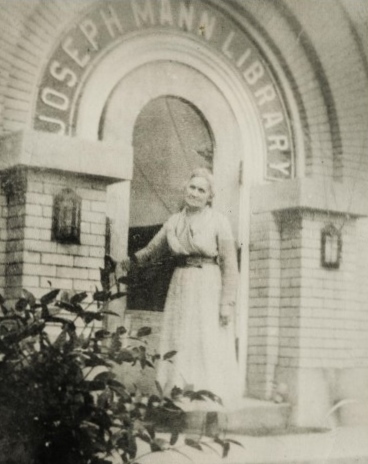
Lizzie Baetz, librarian, in front of the Joseph Mann (Carnegie) Library, c1914-1919 Courtesty Hurbert R. Wentorf Photo Collection, Lester Public Library.
On May 15, 1995, James Lester, Chairman of the Board and CEO of Eggers Industries of Two Rivers, and his wife Barbee offered the Two Rivers City Council $1 million toward the construction of a new library. The City Council readily accepted and on June 28, 1997 the Lester Public Library — named in honor of Jim’s parents, George and Marcia Lester — opened for business.
The first head librarian of the new library was Lizzie Baetz, employed at the old library since 1900. She was replaced by Rosalie Beale in 1919. Three librarians, each serving a few months, followed in quick succession during the early 1920s – Edith Hess, Mary Dow and Dena Lindley. In 1924, Bernice Hocking Knight became librarian, serving 17 years until her death in 1941.
In 1953 and 1969 major library building additions and renovations were completed as more space was needed for collections and programs.
Other librarians included – Theodora Haman (1942-1957), Gertrude Kaminsky (1957-1958), Lee Gregory (1959-1965) and Jessie Lyman (1965-1975). The last Joseph Mann Library directors were Elsie Heitkemper (1976-1992) and Ken Hall (1992-1998).
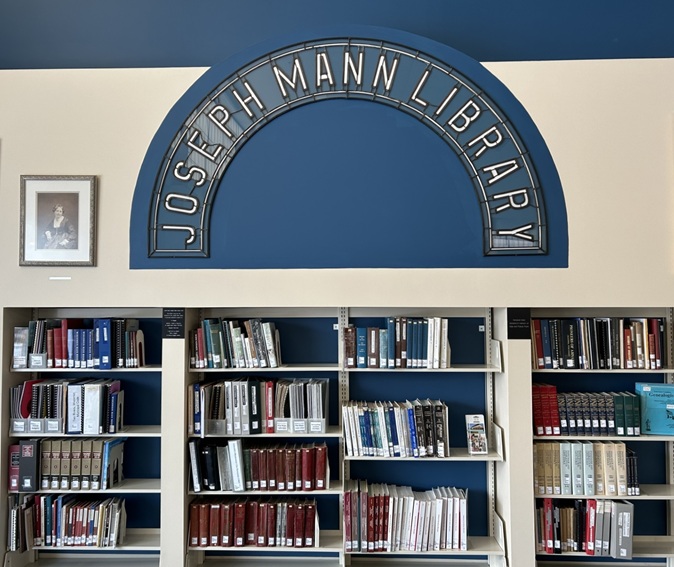
In 1997, the Joseph Mann Library closed when the new Lester Public Library opened in Lakeshore Park. The arched lead glass JOSEPH MANN LIBRARY sign from above the front door of the 1914 Carnegie library is displayed on a wall in the modern, single story facility.
The Carnegie library building, vacant for a number of years, was razed in 2006. Today, the city-owned property is a parking lot.
Memories of the 83-year-old Carnegie library connect us to the past. Generations of local residents recall using the card catalog to find a book, browsing encyclopedias for a school report and attending story hours in the children’s room.
Bob Fay is a historian and former executive director of the Manitowoc County Historical Society.
LEFT: The arched lead glass JOSEPH MANN LIBRARY sign from above the front door of the 1914 Carnegie library is displayed in the Lester Public Library. Photo courtesy of Bob Fay.